

GBP Review Tools Evolve in 2026: Boost Local Visibility with Stronger Engagement Signals


Introduction (40–55 words, snippet-ready)
Recently, Google Business Profile (GBP) performance is being shaped less by “SEO tricks” and more by real customer interaction. Review activity, profile freshness, and engagement signals now influence how businesses show up in Google Maps and the Local Pack. Here are the five factors to prioritise in 2026.
Why GBP matters more for local discovery in 2026
A well-optimised Google Business Profile can drive visibility across Google Maps, Local Pack listings, and location-based organic search.
For many local searches, a GBP listing becomes the first decision point—before a user clicks a website.
That makes reviews, photos, Q&A, and profile activity central to how customers evaluate trust and take action.
The 2026 shift: from “set-and-forget” to active trust signals
Google’s local ecosystem increasingly rewards profiles that look alive and reliable.
This is not just about completing the profile once. It’s about maintaining consistency, accuracy, and visible customer engagement.
According to recent reports, interaction signals—like taps, calls, direction requests, and photo views—are becoming more important alongside review quality.
Top 5 Google Business Profile ranking factors in 2026
H3: 1) Review quality, recency, and response behaviour
Customer reviews remain a primary trust signal for local rankings and conversions.
What’s changing is the emphasis on recency and ongoing review velocity, not just the overall star rating.
Businesses that reply consistently and address concerns clearly tend to look more credible to both users and automated systems.
What to do:
- Ask for reviews in a steady cadence, not in bursts
- Respond to both positive and negative reviews with clear next steps
- Track repeated complaints (timing, service delays, availability) and fix root causes
H3: 2) Engagement signals that show real intent
In 2026, visibility is increasingly tied to how users interact with your listing.
Actions like calling, requesting directions, tapping “website,” saving, messaging, and browsing photos send strong relevance signals.
If people view your profile but don’t act, Google may interpret it as low satisfaction for that search intent.
What to do:
- Ensure your primary category matches the real service intent
- Use service lists and short descriptions that reduce confusion
- Add photos that answer “What will I see when I arrive?”
H3: 3) Profile completeness and entity consistency
Claiming and verifying the profile is still foundational.
Completeness across business name, category, services, hours, website, phone, and attributes helps Google understand what the business is.
Consistency across the web (especially Name–Address–Phone) reduces trust gaps and listing conflicts.
What to do:
- Fill every relevant field, including attributes and services
- Standardise Name–Address–Phone across citations and directories
- Keep categories precise (avoid over-broad category stacking)
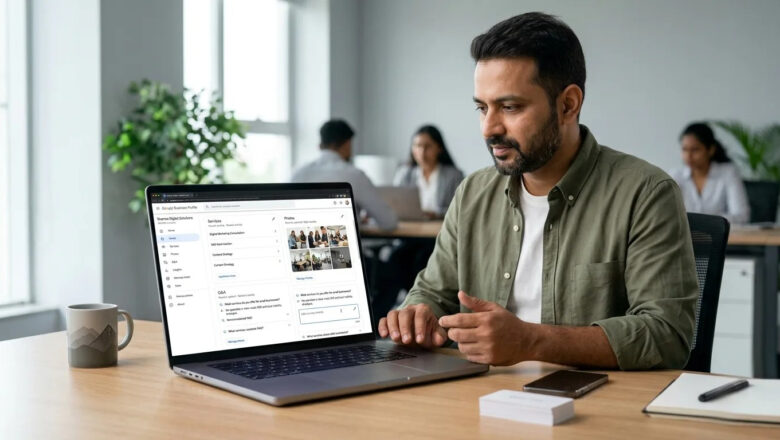
H3: 4) Freshness through regular updates and media activity
An active Business Profile signals operational readiness.
Posting updates, adding new photos, and refreshing offers or announcements can improve visibility and conversion confidence.
Fresh media also supports “visual proof,” which can influence profile engagement and actions.
What to do:
- Post updates consistently (offers, FAQs, service highlights)
- Add new photos routinely (team, workspace, process, before/after where relevant)
- Keep media clean, real, and location-accurate
H3: 5) Accuracy of operational signals
Small details can cause large conversion drop-offs.
Hours, holiday timings, service availability, and contact methods need to match reality.
Keeping “open now” accuracy and business details updated helps prevent user frustration and negative review loops.
What to do:
- Update holiday hours early
- Monitor “suggest an edit” changes
- Keep phone, WhatsApp, booking, and directions links tested
H2: Essential GBP tools businesses are using in 2026
Businesses are combining native tools with local SEO platforms to manage reviews and consistency at scale.
Common categories include profile management, review monitoring, posting workflows, and local rank tracking.
Some teams also use content ideation tools to maintain a steady post cadence without repeating messages
H2: What this means for local SEO strategy
In 2026, GBP is not just a listing. It behaves like a trust layer.
If your profile looks current, gets steady reviews, and drives real actions, visibility becomes easier to sustain.
If it’s outdated or inactive, rankings can decay—even if the business is strong offline.
H2: Final takeaway
GBP review tools are evolving toward trust, freshness, and measurable engagement.
Businesses that treat GBP as a living customer-touchpoint—not a one-time setup—are more likely to earn visibility in Maps and Local Pack results.
Digilogy tracks these local search shifts closely as an industry observer, especially where review systems and engagement signals reshape ranking patterns.