

HUL Sets Record Date for Kwality Wall’s Ice-Cream Business Spin-Off — A Strategic Shift in Frozen Desserts

A Structural Change That Signals a New Direction
Hindustan Unilever Ltd (HUL) has formally announced the record date for the separation of its ice-cream business, including Kwality Wall’s — a move that has been anticipated for months across the FMCG and retail ecosystem.
This isn’t just a corporate reorganisation. It’s a clear strategic statement. The ice-cream business behaves differently from the rest of HUL’s portfolio, and unlocking it as an independent entity gives it the space to move faster and compete more aggressively in a category that relies heavily on cold-chain scale, impulse buying and on-ground execution.
Why the Ice-Cream Business Needs Independence
India’s frozen desserts category is unique. It is seasonal, logistics-intensive, extremely competitive and driven by physical visibility at the last mile. The ice-cream business cannot be managed with the same cadence as personal care or home care.
HUL’s decision acknowledges this difference. As a separate unit, the ice-cream business can focus on product innovation, deeper cold-chain distribution, modern retail expansion and partnerships that require a level of agility that large FMCG portfolios cannot always support.
The move also mirrors global structures within Unilever, where ice-cream operates with dedicated strategies, teams and resources.
What This Means for Kwality Wall’s
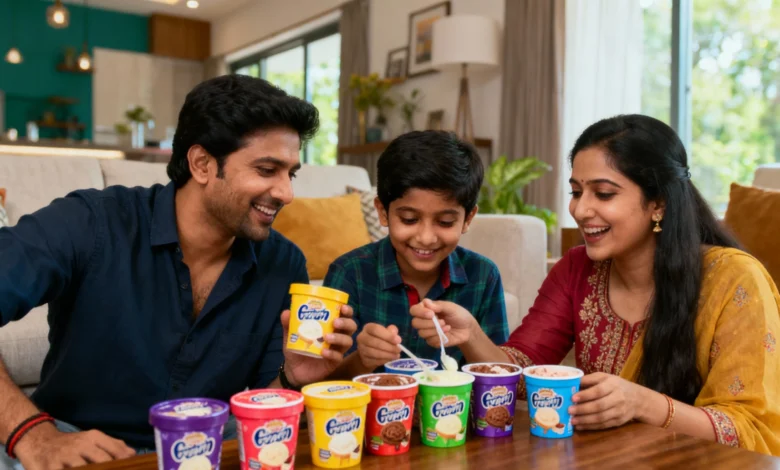
Kwality Wall’s has become a household name across India, shaped by decades of pushcart nostalgia, family packs, Cornetto-led aspiration and consistent presence in urban and semi-urban markets.
The spin-off opens the door for Kwality Wall’s to operate with sharper strategic clarity. The brand can focus on expanding its regional footprint, experimenting with new flavours, testing premium formats and creating category-first experiences without competing internally for attention and capital.
For a category that often grows through on-ground activation and visibility, this independence is crucial. It allows the ice-cream business to behave like a modern food brand, not a general-purpose FMCG unit.
How the Frozen Dessert Market Is Moving
The Indian frozen dessert ecosystem is at an inflection point. Quick-commerce has changed how consumers discover and buy ice-cream. Premium and artisanal brands are rising faster than expected. Local brands in Tier 2 and Tier 3 cities are expanding aggressively.
In this environment, the ice-cream business needs a high-speed model — one that focuses on cold-chain reliability, digital shelf presence, impulse-driven campaigns and predictable availability.
The category is no longer about just price and flavour. It is about visibility, accessibility and innovation cycles that match changing consumer expectations.
Competition Will Intensify After This Move
A stronger, independent Kwality Wall’s means the competitive field will shift. Brands like Amul, Mother Dairy, NIC, Halifax, Havmor and Arun Ice Creams have built strong regional and national presence. Many have deep cold-chain heritage.
With HUL reorganising its ice-cream business, these players will likely strengthen their innovation pipelines and improve distribution further. The market will see more premium SKUs, more tub formats, more regional flavours and expanded presence across quick-commerce platforms.
The next phase of growth is going to be more dynamic — and significantly more crowded.
A Positive Signal for the Broader Frozen Foods Supply Chain
An independent ice-cream business means more investment in cold-chain logistics, retail freezers, temperature-controlled transit, plug-in points at kirana stores and stronger backend planning.
This makes the move relevant beyond HUL. It strengthens the ecosystem and sets higher infrastructure standards for the entire frozen foods category.
Helping FMCG Brands Navigate Structural Shifts
Transitions like this reshape categories. They influence how brands position themselves, how they communicate and how they scale. Digilogy helps FMCG brands adapt to shifts in consumer behaviour, competitive environments and digital visibility.
Get started with Digilogy today and build a digital strategy aligned with the evolving FMCG landscape.