Google High-Intent vs Meta Scale 2026: Understanding the Digital Advertising Landscape

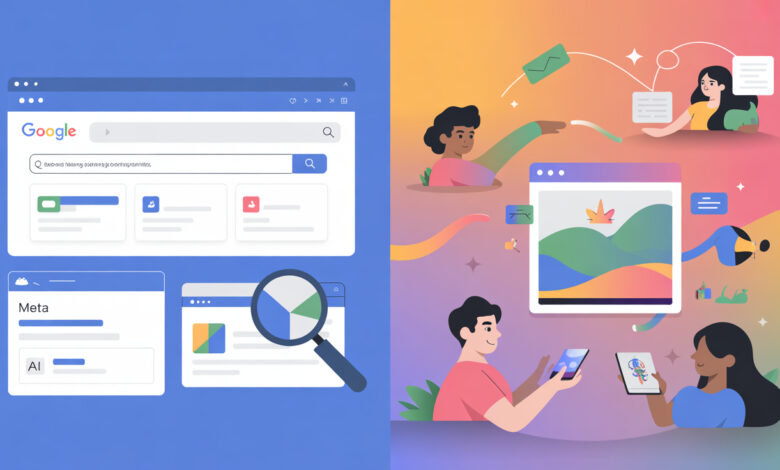
In 2026, the digital advertising landscape will be shaped by Google’s high-intent search for efficient conversion capture and Meta’s massive scale for brand discovery and audience expansion. Both platforms offer distinct strengths that complement each other in the advertising ecosystem. Here’s how marketers can leverage these strengths to stay ahead.
Google High-Intent (Capture Demand)
- Best For: Lead generation, high-ticket items, B2B services, and capturing users with existing intent.
- 2026 Focus: Performance Max campaigns are essential for reaching users via YouTube, Gmail, and search, requiring first-party data and Consent Mode v2 compliance.
- Strength: Predictable ROI, high-quality leads, and strong conversion rates for established search categories.
- Approach: Best for products that solve urgent problems and are actively searched.
Meta Scale (Create Demand)
- Best For: Brand awareness, visually driven products (DTC), impulse-driven purchases, and reaching new audiences via AI targeting.
- 2026 Focus: Expanding “Advantage Plus” campaigns where AI-optimized creative plays a key role.
- Strength: Fast, high-volume campaigns with low CPCs (starting around $0.70 per click) driving rapid creative development.
- Approach: Ideal for demand generation and building brand recognition, especially for products that require discovery through engaging visuals.
Integrated 2026 Strategy
Top performers in the industry use a dual-platform approach, blending Google’s high-intent strategies with Meta’s creative scale for optimal results.
- Use Meta for top-of-funnel discovery to build brand demand.
- Use Google to capture that demand and convert it when users actively search for solutions.
- Cross-platform strategy: Many brands acquire first-time buyers on Meta at a lower ROAS, then harvest high-intent search traffic on Google, where margins are higher.
Actionable Insights for Businesses:
- Google Ads is most effective when users are already showing intent through search behaviors. If you are a local service provider, such as a salon or clinic, Google Ads should be your go-to platform for conversions.
- Meta Ads excels when your goal is broad demand generation. For lifestyle and product-based brands, leveraging Meta Ads will give you better reach at a more affordable cost due to lower CPC rates in 2026.
- A balanced approach, where you test both platforms and scale them based on what works, will be crucial for success.
Final takeaway
Businesses that combine Meta’s audience-building power with Google’s conversion-focused intent will be better positioned to win in 2026. With the right strategy, creative execution, and performance tracking, Digilogy can help brands make both platforms work together for stronger visibility, better leads, and smarter growth.