

Google March 2026 Core Update Weights Core Web Vitals More Heavily

Google recently began rolling out the Google March 2026 Core Update, a broad algorithm recalibration affecting rankings across industries.
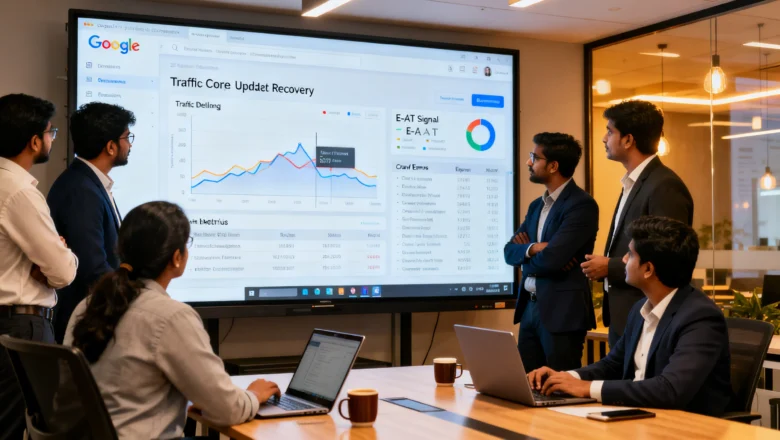
Early analysis indicates stronger weighting for Core Web Vitals, information gain, author credibility, and AI content quality, making both technical performance and content depth central to search visibility.
What the Google March 2026 Core Update Is Changing
Google’s core updates do not penalize websites directly. Instead, they re-evaluate how ranking signals are weighted across the entire index.
The March update appears to place increased emphasis on:
- Real user experience signals
- Content originality and information gain
- Domain authority and topical expertise
- Page performance metrics
- Local relevance and contextual search intent
When multiple pages provide similar answers, Google now prioritizes the page delivering the best user experience and unique value.
Core Web Vitals Receive Stronger Ranking Weight
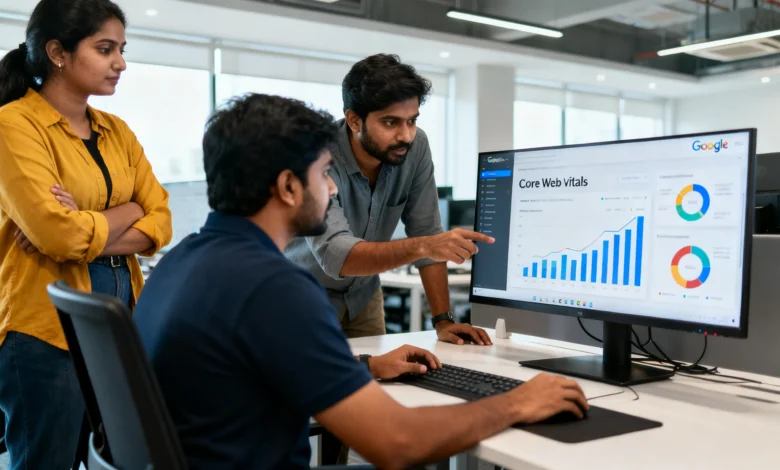
One of the most significant shifts in the Google March 2026 Core Update is the renewed importance of Core Web Vitals performance metrics.
Google evaluates real-world user experience using three measurable signals.
Largest Contentful Paint (LCP)
Measures loading performance by tracking how quickly the main content becomes visible to users.
Good threshold: under 2.5 seconds
Interaction to Next Paint (INP)
Measures responsiveness by tracking how quickly a page reacts when users interact with it.
Good threshold: under 200 milliseconds
Cumulative Layout Shift (CLS)
Measures visual stability by identifying unexpected layout shifts during page loading.
Good threshold: under 0.1
Pages that meet these thresholds tend to deliver faster, smoother, and more stable browsing experiences, which Google increasingly rewards in rankings.
Mobile Performance Now Drives Page Evaluation
Mobile-first indexing has existed for years, but the March 2026 update strengthens its impact on ranking evaluation.
A fast desktop website no longer compensates for poor mobile performance. Instead, Google assesses:
- Mobile loading speed
- Mobile interaction responsiveness
- Mobile layout stability
Sites with slow mobile performance may lose visibility even if their desktop version performs well.
Information Gain Becomes a Critical Content Signal
Another major shift involves information gain, which measures whether content contributes something new to the search ecosystem.
Google increasingly favors content that provides:
- Original insights or data
- Expert commentary or analysis
- Updated research or case studies
- Real-world examples and experiences
Pages that simply repeat existing information without adding value may struggle to maintain rankings.
AI Content Quality Under Greater Scrutiny
The update also strengthens semantic filtering systems designed to detect low-quality mass-produced AI content.
Google is not penalizing AI-generated content itself. Instead, it evaluates whether the content demonstrates:
- Human oversight and editing
- Topical expertise
- Accurate facts and citations
- Clear author credibility
Content lacking these signals may see reduced visibility in search results.
Three Major Google Updates Happening Within Six Weeks
The Google March 2026 Core Update did not occur in isolation. It followed two other algorithm changes released within a short timeframe.
Discover Core Update
Google recently rolled out its first Discover-specific core update, focusing on original reporting and reducing clickbait content in Discover feeds.
Spam Update
Earlier this week, Google also released a spam enforcement update targeting manipulative link schemes, cloaking techniques, and mass AI content without editorial oversight.
Together, these updates have created significant volatility in global search rankings.
Why Core Web Vitals Matter More for SEO in 2026
Core Web Vitals are no longer considered optional optimization metrics. They now represent a core component of technical SEO performance.
Websites with strong Core Web Vitals scores often experience:
- Higher search visibility
- Lower bounce rates
- Longer engagement time
- Improved conversion rates
Recent studies indicate that pages ranking in the top 10 search results consistently show stronger Core Web Vitals performance than lower-ranking pages.
What Website Owners Should Do During the Rollout
Google advises website owners not to make drastic changes during the rollout phase of a core update.
Instead, site owners should focus on monitoring performance using:
- Google Search Console
- Core Web Vitals reports
- Real user experience metrics
- Engagement and conversion signals
If traffic declines, the recommended approach is to improve overall site quality rather than applying quick technical fixes.
Industry Perspective
Digital marketing observers are closely monitoring how the update reshapes search rankings.
According to Digilogy, a digital marketing agency and industry observer, the update highlights the growing importance of combining technical performance, credible authorship, and original insights to remain competitive in search.
FAQs
- What is the Google March 2026 Core Update?
The Google March 2026 Core Update is a broad algorithm update that recalibrates how Google ranks content based on quality, relevance, expertise, and user experience. - How long does the March 2026 core update rollout take?
Google core updates usually take about two weeks to fully roll out across global search results. - What are Core Web Vitals in SEO?
Core Web Vitals are performance metrics that measure page loading speed, responsiveness, and visual stability. - What are the ideal Core Web Vitals scores?
A good score is LCP under 2.5 seconds, INP under 200 milliseconds, and CLS under 0.1. - Does the March 2026 update penalize AI content?
No. Google evaluates content quality and human oversight, not whether the content was created using AI. - What is information gain in SEO?
Information gain refers to how much new or unique value a page adds compared to other pages already ranking. - Why is mobile performance important for SEO?
Google primarily evaluates websites using mobile performance, making fast mobile loading and responsiveness essential.
Final Takeaway
The Google March 2026 Core Update reinforces Google’s long-term shift toward user-first search experiences. Websites that combine fast performance, expert content, and genuine information value are more likely to succeed as search ranking systems continue evolving. As algorithm updates become more interconnected, businesses must treat technical SEO, content quality, and user experience as one unified strategy rather than as separate optimization efforts. Digilogy helps businesses align these elements through integrated SEO, content, and website performance strategies built for long-term search visibility.