India AdEx Digital 70% by 2027: What It Means for Chennai Marketers

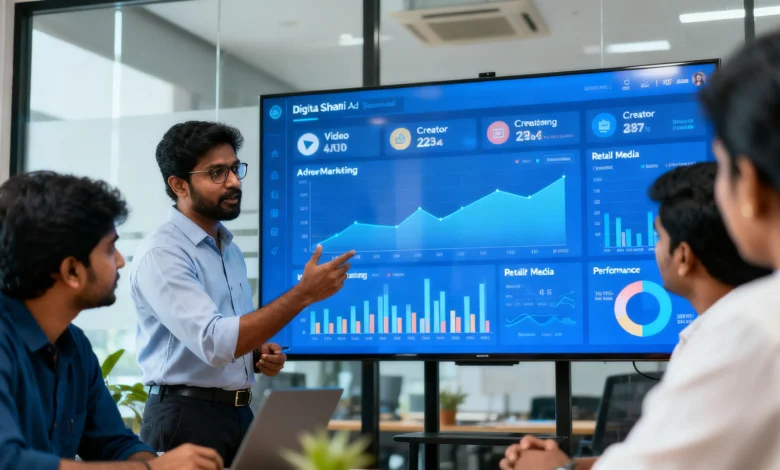
India’s ad market is moving deeper into a digital-first phase. According to recent reports, digital accounted for 59% of total ad spend in 2025 and is projected to reach 70% by 2027, marking a structural shift in how brands plan reach, performance, and measurement.
That matters beyond national media budgets. For Chennai marketers, the signal is clear: future growth is likely to come from regional language content, creator-led influence, online video, commerce-driven media, and measurable full-funnel planning rather than heavy dependence on legacy formats alone. This is an inference based on the national AdEx trendline and the documented rise of regional creators and digital video in India.
India’s advertising mix is being rebalanced
The dentsu-e4m Digital Advertising Report 2026 says India’s total advertising industry closed 2025 at ₹1,21,339 crore, with digital media at ₹71,621 crore. The same report projects digital ad spend to rise to ₹84,977 crore in 2026 and ₹98,034 crore by 2027, taking digital to roughly 70% of total AdEx.
Traditional media is not disappearing, but its share is narrowing. Recent coverage of the report says television is expected to decline to 15% of AdEx by 2027, print to 10%, while out-of-home remains the only traditional medium projected to grow, helped by digital OOH networks and urban infrastructure upgrades.
What is driving the shift to digital
Recent report coverage points to four major growth drivers: mobile-first consumption, short-form video, creator commerce, and AI-powered ad technology. It also highlights social media, online video, and retail media as major demand engines inside the broader digital mix.
E-retail advertising is becoming especially important. The report coverage says e-retail ad spend surged 55.86% in 2025 to ₹17,601 crore, making it one of the fastest-growing digital channels and reinforcing the link between media planning and commerce outcomes.
Programmatic and paid search are also holding strategic relevance. Recent industry reporting says programmatic is expected to account for more than 70% of digital ad spend, while paid search continues to benefit from AI-led feature upgrades that help sustain performance relevance.
What Chennai brands should take from India AdEx Digital 70% by 2027
For Chennai, this is less about copying a national media mix and more about adapting to local buying behavior. A city with strong SME activity, real estate competition, education demand, healthcare growth, retail density, and regional language content consumption is well suited for measurable digital campaigns tied to leads, visits, calls, and commerce actions. This is an inference drawn from the report’s emphasis on measurable outcomes and regional digital growth patterns.
The first implication is content localization. Exchange4media reported that brands are increasingly partnering with regional influencers across South India, especially in categories such as FMCG, beauty, technology, and tourism, because regional creators drive awareness and engagement in culturally relevant ways. Chennai marketers can reasonably apply that lesson to Tamil-first campaign planning.
The second implication is video-led planning. India’s digital mix is being shaped by social and online video, while CTV is moving from niche to mainstream as connected households expand and advertisers seek targeted, high-attention environments. That gives Chennai brands a stronger case for blending short-form social video with premium streaming exposure.
The third implication is performance with trust-building. Recent commentary around India’s digital ad market says brands are no longer treating digital as only a precision channel. Instead, digital is evolving into a full-funnel system that combines scale, storytelling, targeting, and conversion across one measurable framework.
Why OOH still matters in a digital-first market
One of the most interesting findings in the India AdEx Digital 70% by 2027 shift is that OOH remains resilient even as television and print lose share. Report coverage says OOH is the only traditional format expected to grow, supported by digital OOH expansion and improved urban infrastructure.
For Chennai planners, that suggests a connected approach rather than a binary one. Transit-heavy zones, arterial roads, retail clusters, and IT corridors can still play a role when OOH is paired with paid search, Maps visibility, remarketing, and social video to capture both attention and intent. This is an inference based on the report’s OOH outlook and the way omnichannel planning is being discussed in industry coverage.
The likely Chennai playbook from here
1. Move more budget toward measurable digital outcomes
As digital takes a larger share of India’s AdEx, Chennai brands will likely need tighter attribution, better landing journeys, stronger CRM follow-up, and clearer channel-level ROI tracking. That follows directly from the report’s emphasis on performance-led outcomes and accountable media.
2. Build around regional language and regional trust
Tamil content, local proof, city-specific search behavior, and regional creators can help brands compete more efficiently than generic national messaging. This is supported by South India’s creator-led marketing momentum and the broader push toward localized engagement.
3. Treat video as a planning layer, not a format add-on
Short-form Reels, YouTube, online video, and CTV should increasingly work together across awareness and conversion journeys, especially for categories where visuals shape recall and trust.
4. Prepare for commerce-driven media growth
Retail media and e-commerce-linked advertising are scaling quickly in India. Chennai brands selling through marketplaces, D2C sites, or multi-location retail may need media strategies that connect visibility directly to product discovery and purchase behavior.
FAQs
What does India AdEx Digital 70% by 2027 mean?
It means digital advertising is projected to account for about 70% of India’s total ad expenditure by 2027, up from 59% in 2025.
Why is digital ad spend growing faster in India?
Recent reports point to mobile-first usage, short-form video, creator commerce, AI-powered ad tech, and stronger performance measurement as the main drivers.
Will traditional advertising disappear by 2027?
No. But its share is expected to shrink, with television and print declining while OOH remains the only traditional medium projected to grow.
How should Chennai marketers respond to this shift?
They should focus more on measurable digital planning, regional content, creator partnerships, video-first storytelling, and stronger full-funnel conversion systems. This is an evidence-based strategic inference from national AdEx data and regional creator trends.
Highlighted entities used
dentsu-e4m Digital Advertising Report 2026, India AdEx, digital advertising, Chennai marketers, retail media, programmatic advertising, paid search, connected TV, OOH, regional creators, South India, AI-powered ad tech
Suggested internal links
- Digilogy digital marketing services
- Digilogy Contact Us page
Suggested authoritative external links
- dentsu-e4m Digital Advertising Report 2026
- Financial Express coverage of India’s advertising industry outlook
- Exchange4media coverage on digital ad share and regional creator trends
Schema recommendations
- NewsArticle
- Article
- FAQPage
Final takeaway
India AdEx Digital 70% by 2027 is more than a forecast headline. It signals that digital is becoming the default operating system for Indian advertising, with stronger roles for video, creators, commerce, programmatic buying, and measurable performance. Digilogy’s digital marketing services align closely with this shift by helping brands structure search, paid media, content, local visibility, and conversion journeys around real business outcomes.
For Chennai businesses, the opportunity is not just to spend more on digital, but to plan smarter around regional behavior, stronger funnel design, and accountable growth. To discuss how this digital-first shift can be turned into a practical strategy for your brand, visit the Digilogy Contact Us page.