

WhatsApp API Local Billing & Message Recategorization Reshape Business Messaging

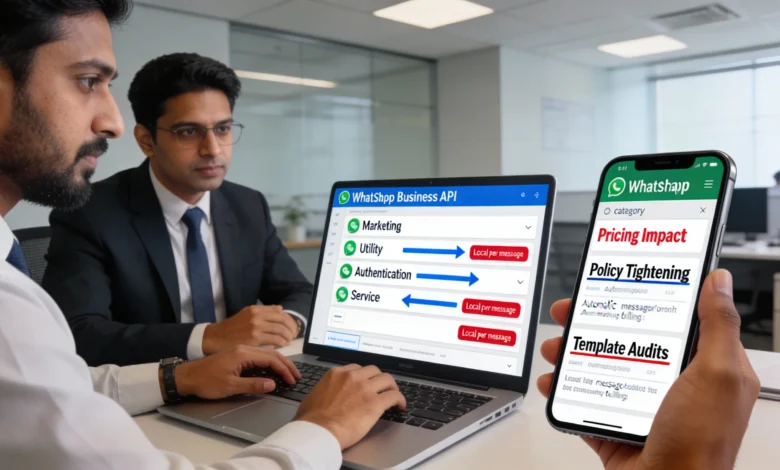
Recently, WhatsApp API Local Billing & Message Recategorization emerged as a major shift in how businesses are charged and reviewed on the platform. Updated policy, API, and template rules introduce stricter message categorisation and a move away from conversation-based pricing, significantly affecting enterprise messaging strategies.
Key Developments
According to recent reports, WhatsApp has tightened its rules around message templates across Marketing, Utility, and Authentication categories.
Templates that combine elements from different categories are now automatically reclassified to the higher-priced category. For example, a utility message that includes a promotional link is treated as a marketing message.
From April 16, 2025, businesses may no longer receive a 24-hour warning before approved utility templates are reclassified. Repeated violations can lead to temporary restrictions on submitting new templates.
How Pricing Worked Earlier
Until July 2025, the WhatsApp Business API followed a conversation-based pricing model.
Businesses paid a fixed fee for a 24-hour customer service window. Within that window, unlimited messages could be sent across categories.
If a customer initiated the conversation, replies and service messages were free, making cost planning relatively predictable.
What’s Changing With Local Billing
From July 1, 2025, WhatsApp is shifting to per-template, per-message billing, marking the core of WhatsApp API Local Billing & Message Recategorization.
Each delivered template message is billed individually based on its category and recipient location. The 24-hour conversation charge no longer applies.
Marketing messages are always charged per delivery, utility messages are free only within an active customer-initiated window, and authentication messages are billed individually.
Industry & Expert Context
WhatsApp’s parent company Meta has stated that charges apply when a message is delivered, not when it is sent.
The platform recognises four message categories: marketing, utility, authentication, and service. Rates vary by market–category pair, with pricing published for transparency.
Free entry points remain available when users message businesses through click-to-WhatsApp ads or page call-to-action buttons, keeping all messages free for 72 hours.
Why This Matters
The WhatsApp API Local Billing & Message Recategorization update directly affects messaging costs, compliance risk, and template strategy.
Businesses that previously mixed informational and promotional content may see sudden cost increases due to automatic reclassification.
The changes also increase the importance of internal audits, clear message intent, and strict separation between utility and marketing communications.
For large-scale senders, volume-based discounts still apply, but only when templates remain compliant.
What Happens Next
According to recent reports, businesses are expected to conduct regular template audits to avoid reclassification and submission restrictions.
Webhook alerts for template category updates can help teams respond quickly to pricing changes.
Industry observers expect further refinements as adoption grows and feedback from enterprise users increases.
Final Takeaway
WhatsApp API Local Billing & Message Recategorization mark a decisive move toward transparent, usage-based pricing and stricter policy enforcement. Businesses that align templates clearly with intent and category will retain cost efficiency, while those that don’t may face higher charges and operational friction.
As an industry observer, Digilogy closely tracks these platform policy changes to understand their impact on customer communication strategies, compliance planning, and long-term messaging ROI.