

Real-Time Signals Power Adaptive Marketing Funnels in 2026

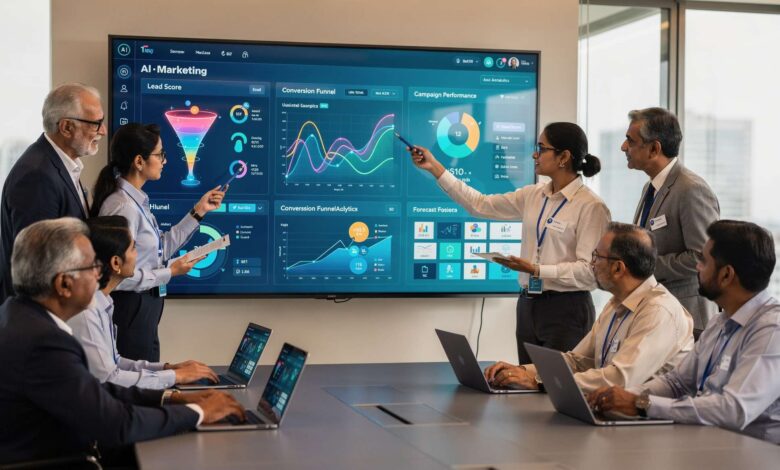
Real-time signals power adaptive marketing funnels as brands shift from rigid, linear campaigns to AI-driven, behavior-responsive systems. According to recent reports, companies embedding predictive personalization into funnel stages are improving conversion rates and reducing acquisition costs.
The traditional awareness-to-conversion path is no longer fixed. It adapts in motion.
The Funnel Is No Longer Linear
Marketing funnels once followed a predictable flow: awareness → interest → consideration → conversion.
Today, customer journeys resemble interconnected loops influenced by micro-actions, device changes, and cross-channel engagement.
Adaptive funnels respond dynamically to:
- Click behavior
- Time on page
- Scroll depth
- Pricing page visits
- Content downloads
The journey adjusts as signals emerge.
What Are Real-Time Signals?
Real-time signals include first-party and third-party data collected instantly across digital touchpoints.
These may involve:
- Contextual signals (location, device, referral source)
- Behavioral actions (video views, downloads, cart hesitation)
- Intent signals from third-party platforms
AI systems analyze these inputs continuously to trigger personalized responses.
How Adaptive Funnels Operate Across Stages
1. Awareness
AI identifies high-intent audiences using predictive targeting and micro-segmentation.
Messaging adapts based on engagement patterns rather than fixed demographics.
2. Engagement
Conversational tools and interactive content respond to user inputs in real time.
Chatbots and dynamic landing pages personalize offers immediately.
3. Consideration
Dynamic content blocks modify messaging based on industry, role, or browsing history.
AI funnel builders such as FERMÀT or platforms like HubSpot Marketing Hub support conditional logic and personalization.
4. Conversion
Adaptive pricing incentives or time-sensitive offers may trigger based on hesitation signals.
Limited-time prompts activate when checkout abandonment patterns are detected.
5. Advocacy
Post-purchase engagement adapts based on satisfaction signals, usage behavior, and referral likelihood.
The Role of Journey Orchestration Platforms
Journey orchestration platforms (JOPs) unify signals across ads, CRM, web, and sales tools.
Platforms such as Demandbase align marketing and sales around predictive account scoring and buying stage classification.
These systems act as central decision engines, ensuring synchronized personalization.
Continuous Testing and Optimization
Real-time signals power adaptive marketing funnels by embedding continuous A/B testing into execution.
Automation platforms:
- Deploy high-performing variants at scale
- Retire underperforming creatives
- Identify bottlenecks automatically
Executives are increasingly institutionalizing testing as an ongoing process rather than a campaign phase.
Measurable Business Impact
According to industry research cited in recent discussions:
- Personalization can reduce acquisition costs significantly
- Revenue lift ranges between 5–15% in adaptive systems
- Marketing ROI improvements of 10–30% are reported when automation is enabled
The gains are realized when systems adapt continuously instead of relying on periodic reviews.
Technology Stack Behind Adaptive Funnels
Core technologies enabling real-time adaptation include:
- Customer Data Platforms (CDPs)
- AI-powered personalization engines
- CRM integrations
- Predictive lead scoring models
- Conversational AI systems
These tools transform static funnels into responsive ecosystems.
Frequently Asked Questions
What is an adaptive marketing funnel?
An adaptive marketing funnel uses real-time data and AI to personalize customer journeys dynamically rather than following fixed stages.
How do real-time signals improve conversions?
They trigger timely, relevant messaging based on user behavior, reducing friction and improving decision momentum.
Are adaptive funnels only for large enterprises?
While enterprise platforms lead adoption, scalable tools are making adaptive systems accessible to mid-sized organizations.
Do adaptive funnels replace traditional marketing funnels?
They evolve them. Core stages remain, but progression becomes fluid and personalized.
Final Takeaway
Real-time signals power adaptive marketing funnels by converting static campaigns into living, responsive systems.
Brands that integrate predictive analytics, continuous testing, and journey orchestration are building resilient, conversion-focused growth frameworks.
Digilogy tracks these industry developments closely. For daily updates and insights, visit the Digilogy News page.